
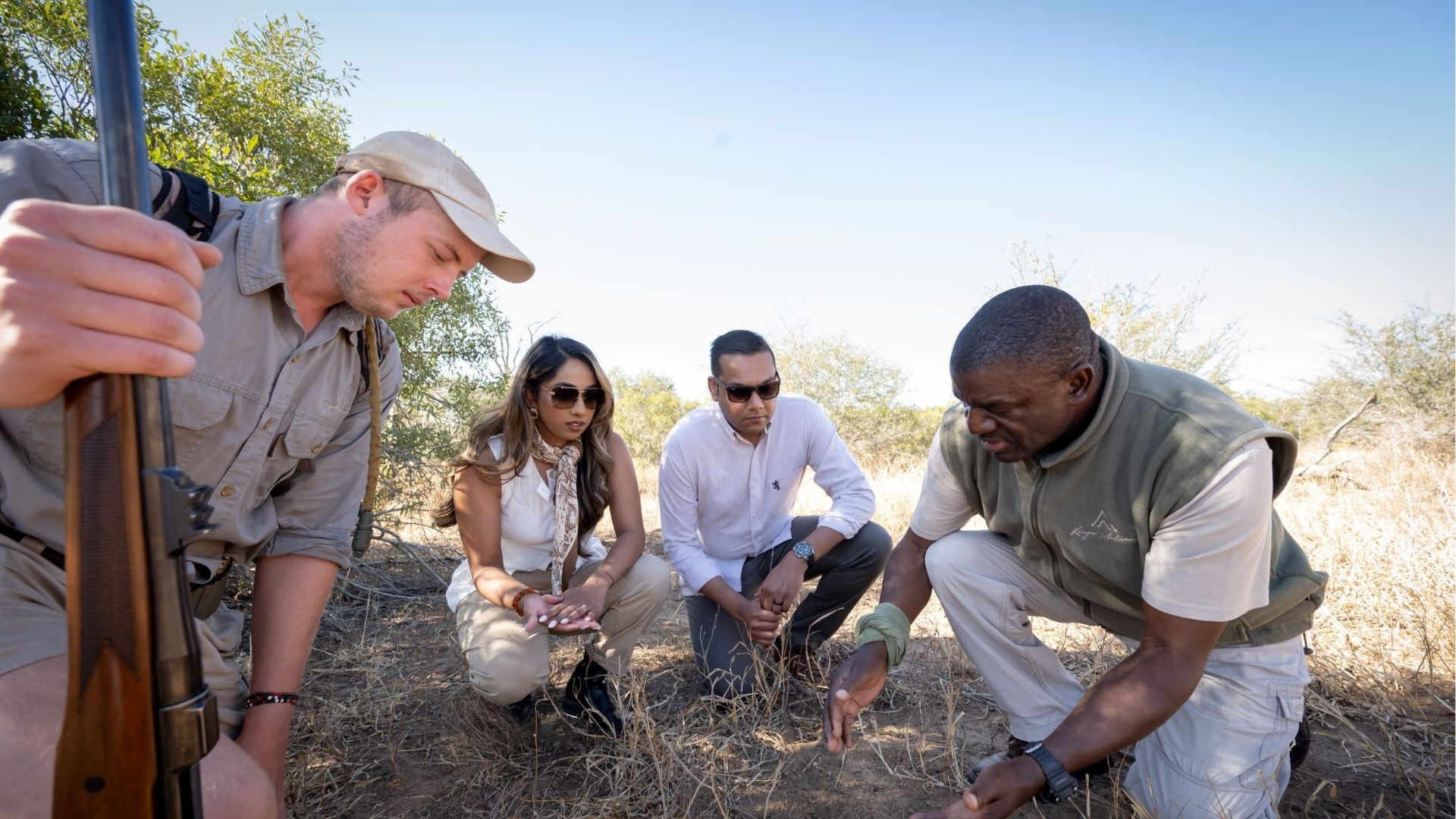
A look at walking and tracking experiences
Walking and tracking are often spoken about in the same breath, yet at Kruger Untamed they are two very different ways of meeting the wild. Both take you beyond the open safari vehicle and into the textures of the landscape, but each invites a distinct state of mind. Walking is about presence. Tracking is about pursuit. One is a widening of awareness, the other a narrowing of focus. Both reveal layers of meaning that remain invisible at a distance.
Walking safaris are part of the DNA of Kruger Untamed and are available at Satara Plains Camp (with booking at least a month in advance required) and as part of the daily offering at Tshokwane River Camp. Tracking experiences also go to the heart of our safari offering and our commitment to celebrating the extraordinary skills of local Shangaan trackers and are offered at Tshokwane River Camp where guests also have the chance to book a tracking experience with master tracker Renias Mhlongo.
So, what’s the difference? Walking safaris are the foundation. They allow you to move slowly through the bush, learning to read it as a living system. Your guide leads with a soft voice and careful steps, encouraging you to widen your attention: the tilt of a grass stem after rain, the scent carried on a breeze, the quiet alarm note of a squirrel.
The pace is unhurried and the purpose is not to reach a destination. It is to see the ordinary with new clarity. You begin to notice what moves first when a herd of impala grazes, or how the shadows shift along the riverbank. This is the type of experience that makes the Kruger feel personal. You are not just observing the wild. You are participating in it with your senses fully open.


Tracking, however, draws your gaze into a single line of intent. It begins with a question: who was here, and when? A clean pad-mark pressed into a strip of pale sand can set the tone for the next hour. Was the animal walking or trotting? Did it pause? Is the spoor fresh enough to follow, or already softened by the morning wind? Under the guidance of a master tracker, these details become an unfolding narrative.
You move with purpose, following your Shangaan tracker, learning to read nuance in ways that take years to master. Each print is a clue. Each bend in the path becomes a moment to reassess. You are trying to find what is no longer there, and in that search you learn to see the bush in a far more textured way.
The beauty of tracking is not only in the possibility of finding an animal, but in the discipline itself. The spoor might lead you into a stand of tall grass where the world compresses into sound and shadow. It might guide you up onto a dusty ridge where the view widens and the track suddenly disappears into hard ground. Some days you reach the animal, and other days the trail dissolves into the heat, leaving only the memory of the journey. Both outcomes teach you something. Both strengthen the connection between the land and the people walking it.
Walking and tracking also differ in the way they hold silence. On a walk, silence is about openness. Guides might pause to describe the way elephants feed on bark or how certain birds respond to predators. Stories flow and then fade back into stillness. Tracking creates a more focused quiet. Words become few. Movements are measured. When Renias lifts a hand, the group stills immediately, drawn into the same line of concentration. Even those new to tracking feel the shift. The silence becomes purposeful, almost electric.
For many guests at Tshokwane River Camp, the walking and tracking experiences blend beautifully across a stay. Each morning begins with decisions shaped by the night before: who passed through camp, which calls carried across the Ripape riverbed, and what the fresh sand might reveal. The camp’s location makes this possible. The river corridor is a natural highway for wildlife, alive with subtle movement at first and last light. When the day is young, the sand is telling stories. The question becomes not just where to walk, but what thread to follow.

These experiences are not separate worlds. They complement each other, feeding different parts of the same curiosity. A morning walk might tune you into bird calls and wind patterns. An afternoon tracking session might sharpen your eye for small, critical details. Together, they deepen your understanding of the Kruger far beyond sightings.
The landscape itself shapes the experience. The riverbed offers clean sand for reading spoor, as well as patches of shade where large herds come to rest. On the surrounding ridges the ground is harder, the tracks fainter, and the search more intricate. In both settings, you learn to interpret not only what you see but how it fits into the rhythms of the bush.
Walking introduces you to the rhythm. Tracking teaches you to interpret its beats. Both experiences are held safely and thoughtfully by the guiding teams, whose skill allows guests to move through the wilderness with confidence. In many ways, this is what sets Tshokwane apart. Tracking is not added as a novelty here. It is part of the camp’s identity, woven into the flow of each day. Walking is not an optional extra, but a way of connecting with a place that rewards those who travel quietly.
In the end, walking shows you the Kruger’s character. Tracking shows you its secrets. One teaches you to see. The other teaches you to look deeper. Together, they reveal a wilderness that feels more layered, more intimate, and more alive with story than you ever imagined.


